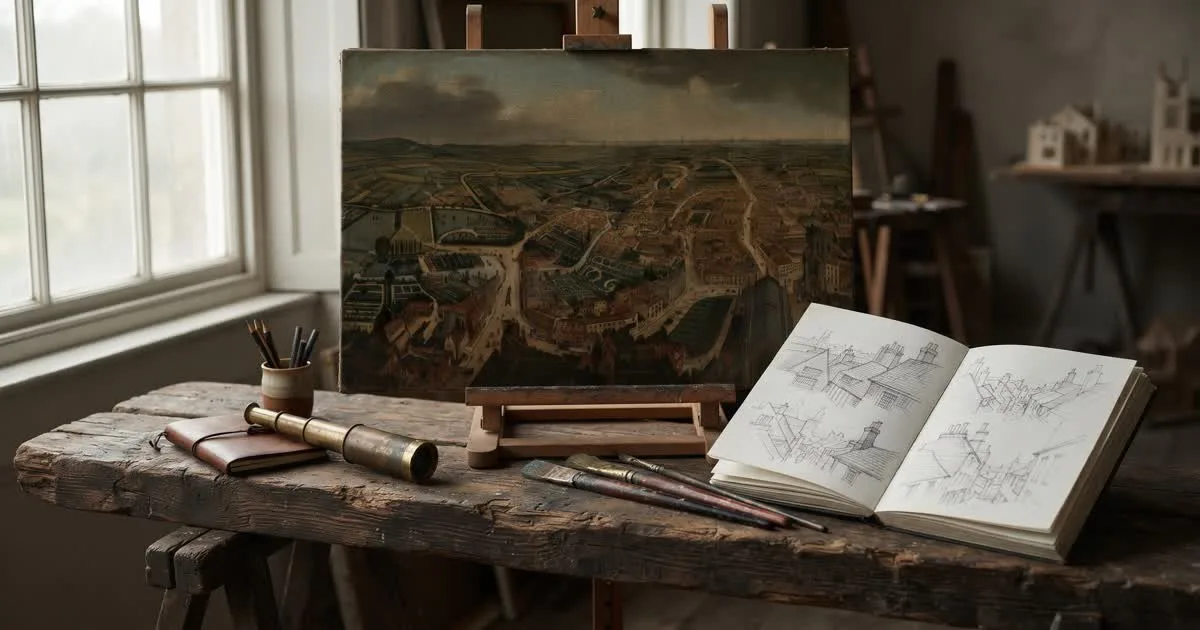
Brown's Panorama is a huge painted view of Louth and the countryside around it, made in the 1840s from the top of St James' spire. It shows the town on a busy summer's day, street by street and garden by garden, and it is one of the best records of what Louth looked like before the railway arrived. You can still see the original today.
William Brown
William Brown was a Louth man through and through. He lived at the Northgate end of Vickers Lane, worked for most of his life as a house painter, and was a Methodist preacher and a teetotaller. From 1839 until he died he was also the local correspondent for the Lincoln, Rutland and Stamford Mercury, so he knew the town's news as well as its streets.
He had 14 children, all with his first wife, but only five reached adulthood. Brown died in 1859.
Painting It From the Spire
In 1844 the spire of St James' Church was struck by lightning, and scaffolding went up to repair it. Brown seized the chance. He climbed to the top and sketched the view in every direction, on seven panels of 51 degrees each. He then turned his sketches into two oil paintings on linen, each about 9 feet by 6 feet, which together make a full 360-degree view. He was 56 when he began the painting stage, and it took him two years.
The word panorama comes from the Greek for an "all embracing view". Brown wanted the viewer to feel they were floating over the town with the flight of an eagle. You can read more about the spire in Tudor and Stuart Louth, and about the town Brown painted in Victorian Louth.
What the Panorama Shows
The panorama shows the pattern of streets and the Market Place, with rooftops that are still recognisable today. The detail is the real joy. Louth Museum suggests looking for horse-drawn vehicles, ladies shopping, a funeral, new garden designs and haystacks in the town. Can you spot the town crier, boys bowling hoops, the workhouse, and the carpet factory with its tall chimney? And how many windmills can you count?
It seems Brown planned to sell postcard-sized copies to local people, which is probably why he included so many named buildings and people, in the streets or in their gardens. The postcards were never made, but the accuracy that Brown put in makes the panorama a valuable historical record. He also kept it up to date after he finished, painting out windmills that had been pulled down and painting in new buildings, such as the Town Hall, which was not built until 1854.
The panorama was first shown at the Mansion House in Louth in 1847 and again at the Corn Exchange in 1856. In 1988 it was part of an exhibition at the Colnaghi gallery in London, which brought it to a much wider audience.
Lost and Found
After Brown died in 1859, the two paintings disappeared. They were not seen again for 92 years. In 1948 the Mayor of Louth, Wilfred Alex Slack, met the wife of the vicar of Alford, who told him she had two "pictures" he ought to see. They were in poor condition, but the mayor realised at once that they had to be bought for the town and restored. With a grant from the National Art Collections Fund and money raised by public subscription, Louth got its panorama back.
Cleaning and Restoration
In 2005 the then Mayor, Councillor Mrs M. W. Finch, led a project to preserve the panorama for future generations. A leading large-canvas conservator, recommended by the British Institute of Conservation, was hired. In December 2006 the canvases left the Town Hall for the conservator's studio in Norfolk, and they came back to the Council Chamber on Wednesday 9th May 2007, cleaned and restored, with special low-reflective glass fitted over them.
When Louth Town Council moved to the Sessions House on Eastgate in 2011, the panorama moved with it.
How to See It Today
There are two places to see Brown's Panorama, and they show it in very different ways.
- The original paintings hang in the Old Courtroom at the Sessions House on Eastgate, the offices of Louth Town Council. Louth Town Council says visitors can view them on Wednesdays and Fridays from 10am to 1pm, or by appointment on other days. Hours can change, so ring the council on 01507 355895 before you go.
- A back-lit digital copy is on display in the Panorama Gallery at Louth Museum, at 4 Broadbank. The museum describes it as a lit, 360-degree view of Louth in the 1840s, and the gallery also has replicas of Brown's original sketches. Louth Museum is normally open from April to October, Wednesday to Saturday, 10am to 4pm, so it is closed in winter. Check its visitor information for current dates and prices.
If you are planning a day in the town, the museum, the Sessions House and St James' Church are all a short walk from each other. For more ideas, see our walks guide, the What's On listings (the museum holds lectures) and where to stay if you want to make a weekend of it.
Books, Video and the Trail
Two books tell the story in detail: William Brown and the Louth Panorama by David Robinson and Christopher Sturman, and The People of the Panorama by Dr Richard Gurnham. Louth Town Council says both are sold at Louth Museum and in local bookshops.
Louth Museum has also made a video called Then and Now Through Paint and Digital Images, which walks through modern Louth using Brown's panorama and a digital camera. Louth Town Council created a Brown's Panorama Trail, a walk around the town with information boards. The council says the boards are not on display at the moment, but its trail page is still worth reading before you set off.
Sources and Further Reading
- Louth Town Council, Brown's Panorama and Brown's Panorama Trail
- Louth Museum, the Panorama Gallery
Details checked 19th November 2026.