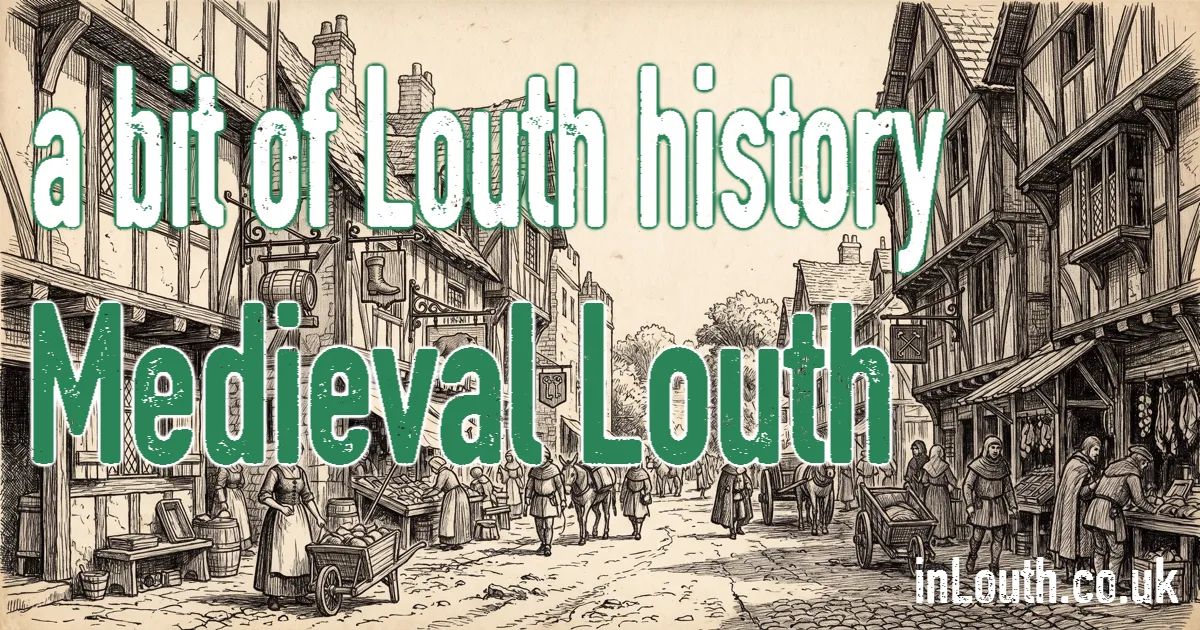
Between the Norman Conquest and the Tudors, Louth grew into one of the most important towns in Lincolnshire. Its wealth came from its market, the wool of the Wolds and the grazing of the Marsh, and from the powerful churchmen who owned and shaped it.
Louth in Domesday Book, 1086
Domesday Book records 124 households at Louth: 80 burgesses (townspeople with trading rights), 40 freemen, 2 villagers and 2 men-at-arms. That put it among the largest fifth of all places in the survey. It had 13 mills and a market, and both before and after the Conquest it belonged to the Bishop of Lincoln. Its value had nearly doubled since 1066, from £12 to £22.
Domesday counted households, not people. Louth Town Council estimates the population at about 600, and the town was one of only five boroughs in Lincolnshire.
The Bishop's Market Town
As lord of the manor, the Bishop of Lincoln laid out a planned town to the east of Upgate, with a large open market place. Over the centuries, buildings filled much of that space, creating the narrow streets around Mercer Row and the Cornmarket that you can still walk today. By around 1300, Louth had about 2,000 people and two eight-day fairs every year.
Louth Park Abbey
In 1139, Bishop Alexander of Lincoln gave Cistercian monks from Fountains Abbey in Yorkshire land in his park just east of Louth, after an earlier site at Haverholme proved unsuitable. Louth Park Abbey became a major house. Its church, completed in the early thirteenth century, was nearly as wide as Lincoln Cathedral and 70 feet longer than today's St James' Church.
The monks brought water to the abbey along the Monks' Dyke, a channel about two miles long, and their sheep and wool linked Louth to markets overseas, including Flanders. Today only earthworks and fragments of the church remain above ground, but considerable remains are thought to survive beneath the fields. The site is a scheduled monument.
Alvingham and Legbourne
Louth Park was not the only religious house nearby. At Alvingham, a Gilbertine priory housed both canons and nuns, under the rules of the only English-founded monastic order. At Legbourne, a small Cistercian priory of nuns was founded after 1150. All three would be closed by Henry VIII.
Trade, Fairs and the Port at Saltfleet
Wine and wool were Louth's main trading goods by the time of Domesday. Before the canal, goods travelled to and from the coast through Saltfleet, then an important harbour with its own market, and through Grimsby. Along the coast, salt-making shaped settlements such as Marshchapel.
Townspeople were never far from farming. Louth had its open fields, common grazing and riverside meadows, and the Wolds around it were dotted with villages, some of which were later abandoned, such as Biscathorpe and Walmsgate.
The Black Death
Plague reached the area in 1349. The Louth Park chronicler wrote that in many places fewer than a fifth of the people survived. The shock to farming and labour helped empty some of the smaller Wolds villages over the decades that followed, alongside changes in farming and the spread of sheep pasture. In 1377, poll tax returns record 680 people in Louth.
Guilds and a New Church
Louth's craftsmen and traders organised themselves into religious guilds, part trade association, part charity, part club. Seven are known, and two became rich and influential landowners. Their money helped transform the parish church. Its chancel and nave were rebuilt between 1430 and 1440, Louth Town Council records that it was rededicated from St Herefrith to St James around this time, and its tower was finished by 1499, ready for a spire. That story continues in Tudor and Stuart Louth.
Sources and Further Reading
- Open Domesday: Louth
- Louth Town Council, Saxon times to the 20th century
- Lincolnshire Heritage Explorer: Louth Park Abbey
- Historic England, Louth Park Abbey scheduled monument
- Lincolnshire Heritage Explorer: Louth