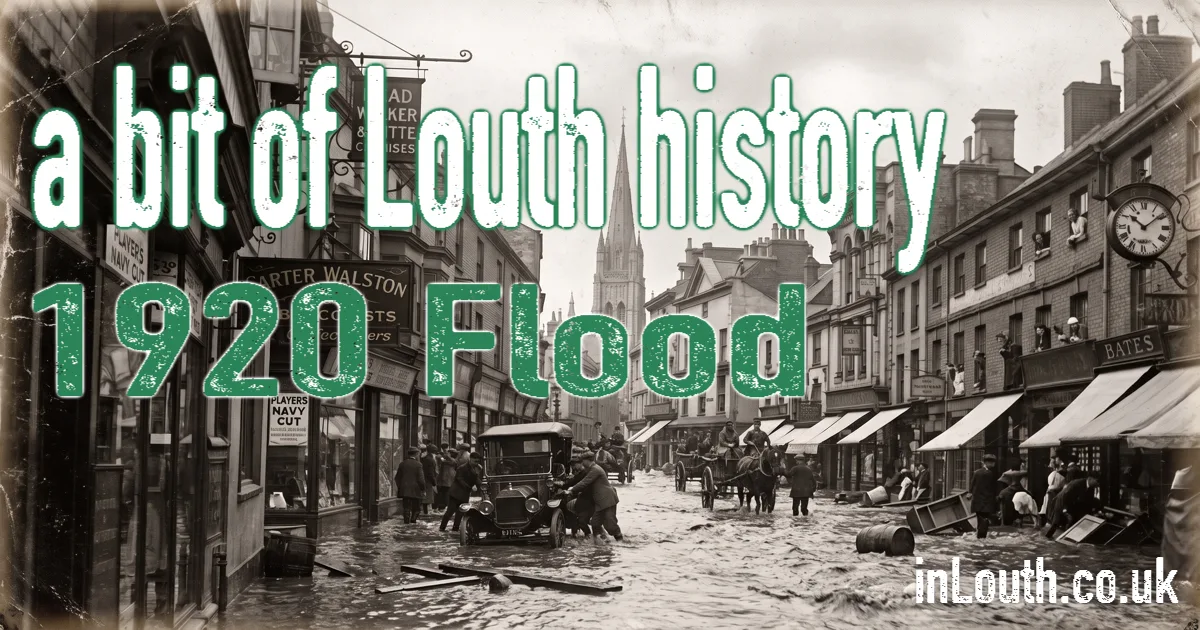
On the afternoon of Saturday 29 May 1920, a sudden flood swept through the middle of Louth. In little more than an hour, 23 people drowned, homes were torn apart and hundreds were left homeless. It remains the darkest day in the town's modern history.
The Storm
The afternoon brought a heavy thunderstorm over the Wolds west of Louth, with thick grey mist and vivid lightning. More than four and a half inches of rain fell on the 22 square miles of the River Lud's catchment in under three hours, millions of tons of water running off the hills towards the town. Some accounts give even higher rainfall. The edge of the storm reached Louth at about 4.30pm.
The Flood
Upstream at Little Welton, branches and debris had built up into a natural dam across the river, holding back a deep body of water. At about 5pm it gave way. A wave around 14 feet high raced down the valley and struck the road bridge at Westgate, throwing coping stones 20 feet and damaging Westgate Mill, before crossing the town in a swathe about 50 yards wide.
The water poured through Bridge Street, Enginegate, Eve Street, James Street, Wellington Street, Ramsgate, Eastgate and Riverhead Road. The fire station on Enginegate collapsed and a fireman was swept away. At Riverhead, barges were torn from their moorings. The greatest loss of life was in Ramsgate. The rain stopped by 5.30pm, and by 6.30pm the water was beginning to fall.
The People Who Died
Twenty-three people died, aged from one to 82: the youngest, Edith Doreen Berry, was a year old, and the oldest, Charles Thorn Smith Mitchinson, was 82. Many were buried at London Road Cemetery on 1 and 2 June, when the Mayor asked businesses to close for the afternoon. On the day of the flood itself, a baby, Frances Kirman, was born in the town.
Homeless and Rebuilding
Fifty houses were destroyed beyond repair, another 250 had to be rebuilt and about 500 more were damaged. Around 800 people were made homeless, and 380 families needed help. The Town Hall, the workhouse and the hospital on Crowtree Lane took people in, and the Congregational Schoolroom on Cannon Street handed out donated clothes and toys. Gas supplies failed and drinking water had to be boiled.
The Mayor's relief fund raised £90,000 from all over the country, equivalent to millions of pounds today. Families who had lost everything were housed in tents on High Holme Road, nicknamed "Canvas Town", and then in 60 wooden huts, "Hut Town", which stood until 1930, when High Holme Crescent was built in their place.
Remembering the Flood
A memorial at Louth Cemetery on London Road lists the names of all 23 people who died. It was cleaned and restored for the flood's 100th anniversary in 2020. Louth Museum holds eyewitness accounts, including that of pupil teacher Helen Sharpe.
Flooding Since
The Lud can still rise fast. Louth was flooded again in the summer of 2007, and in response the Environment Agency built a £6.5 million flood alleviation scheme, with two flood storage areas upstream of the town on the Lud and Hallington Beck. It was formally opened on 28 July 2017. Read more in Louth Since 1900.
Sources and Further Reading
- Louth Town Council, the Great Flood of Louth, 1920, which lists everyone who died
- Louth Museum, an account of the flood by Helen Sharpe
- 1920 Louth flood on Wikipedia
- Environment Agency, Louth and Horncastle flood schemes formally opened