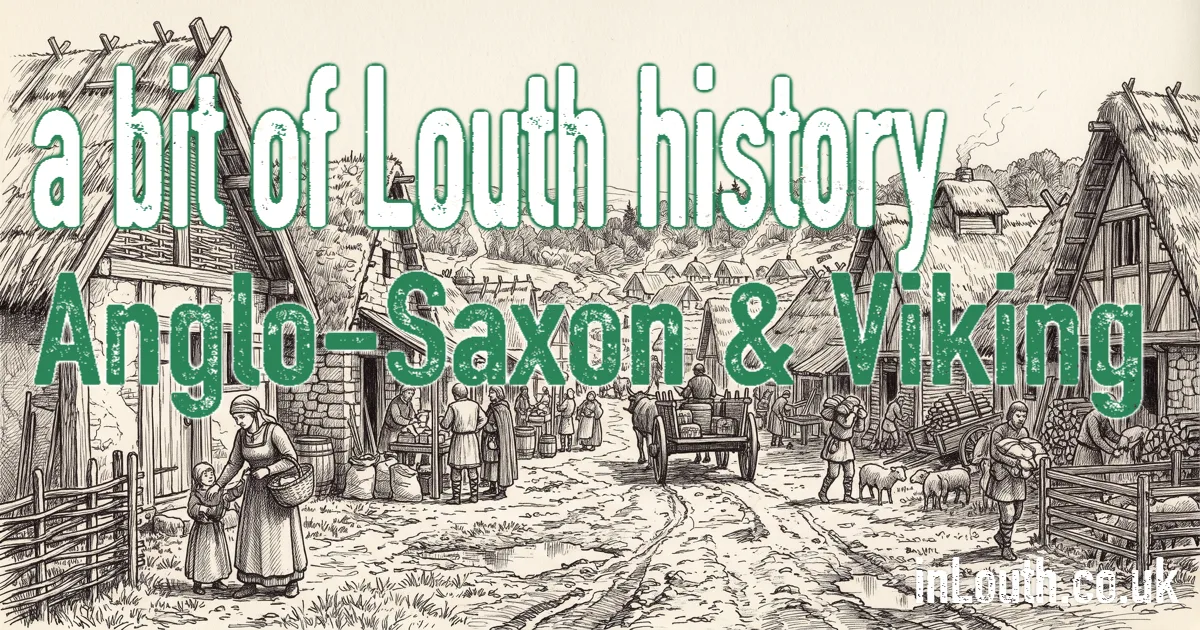
Louth as a place begins with the Anglo-Saxons. By the time of the Norman Conquest it was already an important religious centre and a busy market settlement. This page covers the five centuries or so before 1066.
The First Settlers
Anglo-Saxon settlers arrived around Louth towards the end of the fifth century. The clearest evidence is a large cremation cemetery on the border between Louth and South Elkington. Excavations in 1946 and 1947 recovered many decorated urns, some now on display at Louth Museum, and the diggers estimated that the site held around 1,200 burials, though only about a quarter of it was excavated.
Two brooches found on the outskirts of the town, one typical of the fifth century and a more elaborate one probably from the sixth, suggest a second cemetery, probably on the crest of what is now London Road.
The Name Louth
Louth takes its name from the River Lud, from an old word meaning "loud", fitting a fast-flowing chalk stream that once drove up to 13 watermills. The change from the river's "d" to the town's "th" is put down to Scandinavian influence. The name is first written down around 1100, but it is clearly much older.
A Minster and an Archbishop
By the late eighth century, Louth was home to an important minster, a religious community serving the surrounding area. It produced St Æthelheard, Archbishop of Canterbury from 792 to 805, the last archbishop appointed under King Offa of Mercia. Nobody has yet found where the minster stood, but its importance helps explain why Louth grew into a major town.
St Herefrith, Louth's Own Saint
Louth had its own Anglo-Saxon saint, Herefrith. He is thought to have been one of the last bishops of Lindsey (the old kingdom covering this part of Lincolnshire), around 870, and he may have been killed by the Vikings, though how certain any of this is remains debated. By the tenth century there was a shrine to him in Louth, and the medieval church was dedicated to him before it was rededicated to St James in the fifteenth century.
The Viking Influence
From the late ninth century, this part of England came under Scandinavian control, and the settlers left their mark in the language. Louth's streets ending in "gate", such as Eastgate, Westgate and Upgate, come from a Norse word for a street or way, and many nearby villages end in "-by", the Norse word for a farmstead or village, from Grimoldby and Manby to Saltfleetby.
The Louth Cross
In 2016, two joining fragments of a carved stone cross-head were found during routine work in the rectory garden. Both show the crucified Christ. Specialists David Stocker and Paul Everson dated them to the tenth century, making the cross by far the earliest Christian object found in the town. It was probably a large monument several metres high, and it may be connected with the shrine of St Herefrith.
By 1066, Louth was a prosperous place, held by the Bishop of Lincoln. Domesday Book, twenty years later, opens the next chapter: Medieval Louth.
Sources and Further Reading
- Louth Museum, Anglo-Saxons in early Louth
- Caitlin Green, the discovery of a tenth-century Louth cross
- Lincolnshire Heritage Explorer: Louth
- Louth Town Council, Saxon times to the 20th century