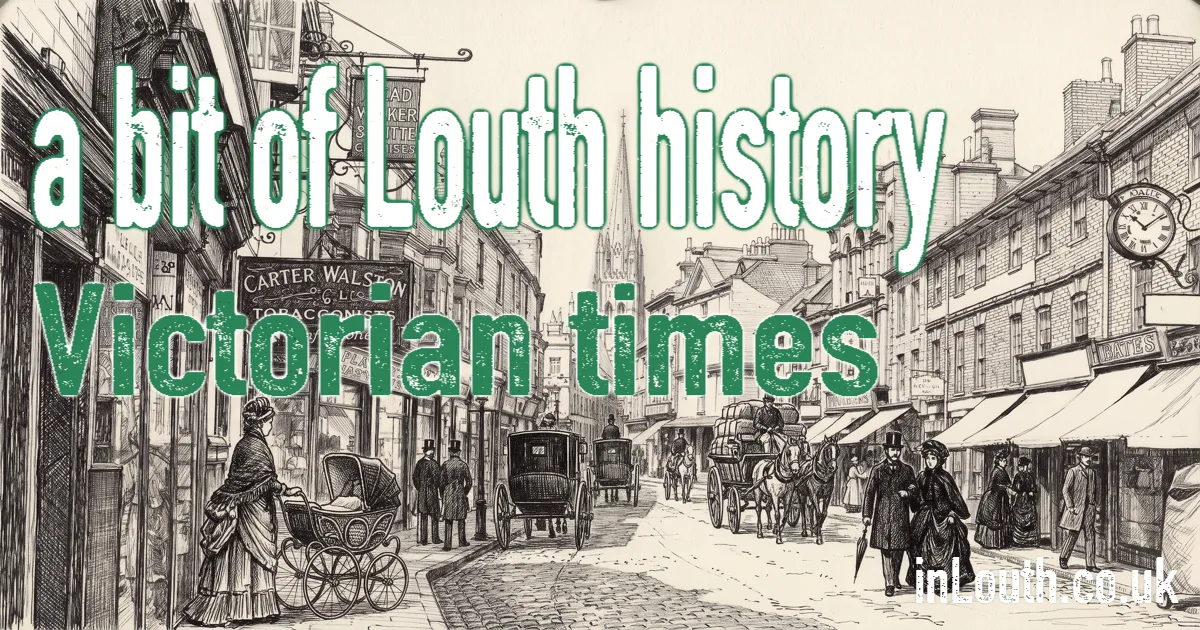
The nineteenth century turned Louth into a busy Victorian market town. A young poet published his first book here, the railway arrived, new public buildings went up, and the population more than doubled before farming hit hard times.
Tennyson's First Book, 1827
Alfred Tennyson, later Poet Laureate, grew up at Somersby in the Wolds and was a pupil at King Edward VI Grammar School in Louth from about 1816 to 1820. In 1827, he and his brother Charles, with some help from their brother Frederick, published their first collection, Poems by Two Brothers, through J. and J. Jackson, booksellers and printers in Louth. The Jacksons paid £10 for the copyright.
A New Borough and the Workhouse
Under the Municipal Corporations Act of 1835, Louth's old corporation was replaced by an elected borough council. Two years later, the new Poor Law brought the Louth Union Workhouse, built in 1837 on what is now High Holme Road and designed by George Gilbert Scott, later famous for St Pancras station, with his partner William Moffatt. It was built for 350 people. It later became Louth County Hospital, and the hospital still stands on the site.
The Railway Arrives
On 8 July 1847, the foundation stone of Louth station was laid by Charlotte Alington Pye, who would later become a well-known songwriter under the name Claribel. The East Lincolnshire Railway opened between Grimsby and Louth on 1 March 1848, and south to Firsby, for Boston, on 3 September that year. The station, designed by Weightman and Hadfield in an Elizabethan style, survives today, converted into homes.
Branch lines followed towards Bardney and Lincoln in the 1870s, and to Mablethorpe in 1877, bringing holidaymakers to the coast and livestock to Louth's market. The railway took trade from the canal, which began a long decline.
A View From the Spire
In 1844, while the spire was covered in scaffolding for repairs, local artist William Brown climbed it and sketched the town and countryside in every direction. The panorama he painted from those sketches shows streets, shops, gardens, carts and people going about their day, and it's one of the great treasures of Louth Museum.
New Public Buildings
The middle of the century brought a burst of building. The Corn Exchange in the Cornmarket, designed by Pearson Bellamy, had its foundation stone laid in July 1853 and opened in January 1854, at the heart of the Wolds grain trade. It was demolished in the 1970s.
The Town Hall on Eastgate followed in 1854, the new cemetery on London Road in 1855, and the Market Hall in 1867, still home to Louth's indoor market.
Art, Music and Learning
Victorian Louth had a lively cultural life. Alongside Brown's panorama and Claribel's songs, Thomas Wilkinson Wallis became nationally known for his remarkably lifelike woodcarving. Many local churches and buildings were designed or restored by the Louth architect James Fowler. The Louth Naturalists', Antiquarian and Literary Society, which would go on to found Louth Museum, began in the later part of the century.
Hard Times
Louth's population grew from 4,258 in 1801 to 10,827 in 1881, its Victorian peak. Then an agricultural depression in the last decades of the century hit the farming economy the town depended on. Many people emigrated to America and Australasia, and by 1901 the population had fallen to 9,619.
Sources and Further Reading
- Louth Union Workhouse on workhouses.org.uk
- Lincolnshire Heritage Explorer: Louth station and the former Corn Exchange
- East Lincolnshire Railway on Wikipedia
- Louth Town Council, Saxon times to the 20th century